Mostrando entradas con la etiqueta Review. Mostrar todas las entradas

sábado, 18 de septiembre de 2021

Witchburner (Indie Review)


The indie title I am reviewing this time it's Witchburner by Luka Rejec. Inside the book we are presented with a dark fantasy setting of heavy and somewhat dense writing in a certain romantic style.  


The rules are simple and draw inspiration from early editions of D&D (OSR) and also from contemporary narrative-centric games. The game tells us about a very concrete situation, where the players occupy the role of investigators who are called by a village in the middle of nowhere to find the witch that makes their lives a torment. The time period of the title seems to be set at the beginning of the industrial revolution and the religion reminds me of the ecclesiastical structure of game of thrones, you know, many gods and elaborate rituals that go beyond praying and singing.


The point is that the players are in a small town and must find the witch who is generating countless evils on the innocent villagers. The plot is extremely simple, but we have the description of 30 npcs and several random tables that will allow us to generate conflicts and tensions between the characters and the villagers. Another very important element is that we have a detailed chronogram of the events that could happen during 30 days, each day divided into morning, afternoon and night. 


These 30 days could be defined as the time limit for the group to find the witch or better yet, escape from the town, an option that, as the days go by, starts to look like the most sensible one. And although there are rules for the resolution of conflicts and the development of combats, much of what happens in the game will depend on the observations and especially on the relationship that the players have with each of the 30 main villagers.


The most interesting part of the game are the villagers, because the feeling that each one of them has towards the players is fundamental to define the path of the adventure. For example, if most of them harbor hatred or resentment towards the characters, then the investigators will end up being the ones accused of witchcraft.


In Witchburner the experimental aspect does not come from the rules, the innovation is found in the construction of relationships as a method for conflict resolution. The characters could act like madmen and burn whoever they want, but they still get more allies and opponents who will get them into more trouble.


I love the month-by-day guide that the book has, since it helps to divide the events and to have a precise follow up of the scenes and situations in the village. But I must say that I don't like the narrative material that accompanies the descriptions of the npcs, I'm sure many people enjoy it but the style is too cryptic and doesn't tell much about the life of those characters.


What I can't deny is that the adventure captivated me, obvious reason why I narrated the whole adventure but using other rules. Instead of following the book's suggestions, I preferred to use a trusty old school manual, but keeping the time rule and the town's love rule. 


By time rule, I mean that the game suggests keeping only three possible interactions with npcs per day per player or group, so that they are forced to plan their days in case they want to move forward with the investigation. On the other hand, with the love of the people, I mean that Witchburner has a list of the main npcs in which you should note whether they love, hate or are indifferent to the party. The more people love them, the more the npcs will be willing to burn the folks that hate the players, but if hate wins out, the adventurers will most likely have the npcs end up at the stake. 


In the same way, pay special attention to the rules related to the witch's trial, in which there are some indications or evidence requirements (mandregoras under the bed, dead cats under the table, dream catchers, drawer full of worms, etc...), which need to be gathered to convince the jury of the town.


It could be said that if the group has managed to burn the witch, everything has ended satisfactorily, although the best of all is that the book has several options to complicate the picture. The group of 3 investigators that I had to narrate, managed to stay successfully for 17 days in the village, accused 3 people of witchcraft, but ended up releasing them for lack of evidence. And who knows, maybe the group would have continued with their investigations had it not been for the accumulated hatred of so many inhabitants. So the only thing left for them to do was to escape from the town in order to save their own skin. 


Although it seems to me that the pdf has a high cost, I recommend that you get the adventure on discount dates. What I am sure of, is that from now on I will have the works designed by Rejec under my gaze. 


martes, 6 de julio de 2021

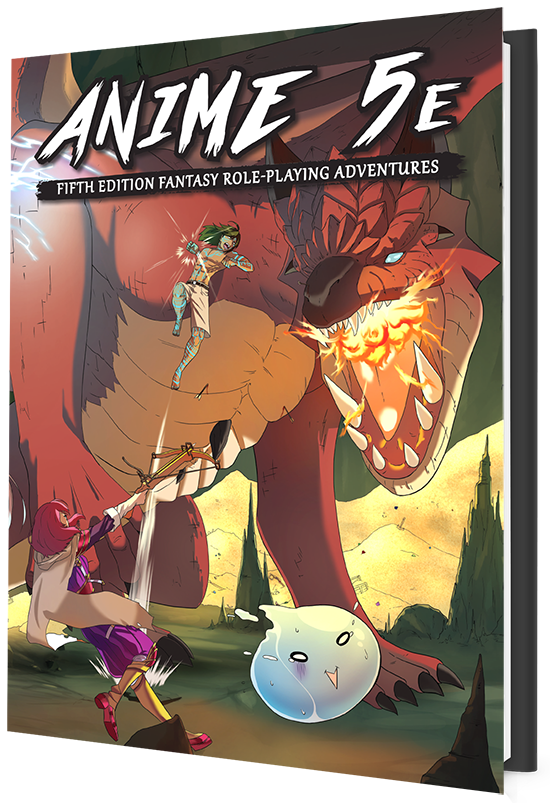
Anime 5e a big little mess


The recent "anime 5e" book remains a reincarnation of the Big Eyes Small Mouth game, which is a good thing but also a bad thing. Character creation takes up most of the manual and is based on a point system that relates to the 3rd edition of DnD. That is not a crime, but it defeats the purpose of the 5th edition, which was intended to simplify the previous system.

We are fortunate that the creators of "Anime 5e" are aware of the problems with their system, so the manual has a detailed explanation of the changes, sometimes too detailed.  

In practice, I don't like the character creation system, I would have preferred that the points expenditure be reduced to the Ranks and defects section, leaving attributes, race and class out of the calculations. With all the changes, character creation takes longer and in the absence of examples, the creation of powers, special moves and flaws takes a long time and largely depends on the flexibility of the DM. 

The good thing is that the manual indicates the type of damage, defense and ranks that each character should have according to their class level, which simplifies things and avoids exploiting the system. And I keep talking about ranks, that new element represents the level of a special ability, either flying, having more defense, teleporting, changing appearance, healing and other suggested powers. Its rank depends on the character's level, which makes nothing too crazy. 

Combat does not change in essence, it is the same as 5th edition, magic does not move too much either. And the enemies can be as complicated as you wish, since the book lets you use the CR system, which remains unchanged.

The fact that there are no major changes in the rules is somewhat positive in the sense that it allows anyone with experience in 5th edition to know in advance what they are playing. But on the other hand, much is lost, as several optional rules would have been welcome. We miss rules for a lightning duel, sacrifice, adding all the power of your allies in a single attack and any detail related to shonen style. 

I can't make a definitive review yet, as I have yet to play a long campaign using the manual. During the campaign I am about to start with this manual I hope I can keep a balance with the system of flaws and powers, especially with the flaws, since they add several possibilities to the narration and creation of conflicts. 

I'm excited about the possibilities of the system and its ability to adapt to a myriad of settings, but all the new rules and class capabilities to take into account make me very nervous. I hope everything goes well, I'll keep you posted. 


jueves, 15 de octubre de 2020

Fermentum Nigrum Dei Sepulti (LOFTP) Review

  A couple of nights ago I finished reading the module of "Fementum" edited by Lamentations of the Flame Princess, and I can say that in many aspects it is a classic D&D adventure but with a huge amount of random tables, which serve to generate an extremely violent and random start of the conflict. 


ART

The module has several finishes that refer to the typeface and religious documents of medieval times, which fits well with the type of adventure, which is based on the novel of the name of the rose and a series of experts on medieval brewing. It sounds a little strange, but everything is well explained and the images serve as a suitable background.

By way of criticism, it seems to me that some of the illustrations are in the way or are larger than they should be, unnecessarily extending the length of the book, which seems to be a one-shot but reaches 100 pages, a situation that in the 90's was considered the norm, but now seems to me to be a bad use of space.

And although art achieves its mission of transporting us to a specific moment in history, it totally fails to generate repugnance or surprise, almost all the illustrations are plain and most of them work.

STRUCTURE

The structure is largely efficient, since all the information is distributed in a sequential way, where the information you may need at the moment is easy to locate, the beginning of the adventure is in the first pages and the end in the last ones, the information is clear and the skills of the creature (one of the best points of the module) are well explained. But the problem is that in some parts the information is a bit excessive, especially in relation to certain tools, which are important, but I feel that it would have been better to summarize the information in a compact format where the main ideas are indicated.

The story is not at all complex, the adventurers must visit St. Christopher's Abbey, they may have some encounters on the way, but once they arrive at the temple, they will have to use all their skills to solve the random conflicts or escape with life, carrying the slight illusion that they are not making the situation of the small world they inhabit worse. Throughout the module there is a historical context of the place, the castle, preparation of the beer, labors and beliefs of the monks locked up in the abbeys. In the same way, the events that happened weeks before the adventure began are detailed, as well as the nature of the creature and a great number of tables that will define part of the events, many of which do not need the presence of the players to be carried out. 

CONCLUSIONS

Although I don't feel the purchase of Fermentum Nigrum Dei Sepulti is mandatory, the truth is that the module has everything necessary to generate a somewhat frenetic and exciting game experience, which can be better if you have the full cooperation of the players and a good reading of the whole module. This is not just another adventure, as it has its unexpected twists and that bizarre/loftp touch, but it lacks it. I like it, but it lacks more personality or interesting npc's.

lunes, 5 de octubre de 2020

As an introduction a REVIEW

Greetings. I'm Mexican Dice

I hope you enjoy my content related to tabletop RPGs, at the moment I'm designing material for the Dungeon Master Guild and I opened this blog to have a way of contacting with al interested people in doing so, with nothing more to say.

The F... review!

A few months ago the adventure "Big Pupet" was published and I was surprised not to find a specific review of this book published by Lamentations of the Flame Princess, although after reviewing the material several times I admit that it's  hard to review it without falling into spoilers.


ART


The strongest point of "Big Pupet" is found in its artwork section which accompanies and shapes the world that is presented to us, since almost all the pages have images similar to those of the cover in a collage style, which surprises and generates repulsion in equal parts. The quality and abundance of the images has a clear sense and although they do generate some displeasure it's well done.

The weak part in this section is related to the illustrations of the maps since they are extremely simple and break with the style presented throughout the module. Likewise, it is strange that there is no image where it is possible to observe the whole city where the conflict takes place.


STRUCTURE

The adventure in this section has another weak point, because although it begins by explaining in a general way what the game is going to be about, soon it get lost and start by detailing information about the antagonists, then go to the locations and other important elements for the plot, while constantly reversing between themes and this happens for more than half of the book.

Although it may seem very complicated what is happening, it bothers me to know that everything could be solved with some boxes dedicated to point out the details of vital importance, because in the middle of a session it can be very annoying to find a relevant piece of information.

But not everything is negative, inside the module there is a section dedicated to provide a basic guide on how to use this module, but that make obvious the author's incapacity's. In itself, it is not complicated what is happening, the players are invited to a theater, they begin to notice strange things that happen in the city and act as they wish, that is the essence. The hard part starts when they are confronted with the antagonists, since the results can be very varied. This module needs an experienced narrator.

But undoubtedly the antagonists are a great asset to the story, because although they do not have a complex background, being divided into factions, they can generate interesting interactions with city dwellers and players. 


CONCLUSIONS


Big Pupet is a mess, but I'm looking forward to a one-shot of the strange module, in general I don't think the described facts will last for more than three games, so in my opinion it's a short game. The creature's features and abilities are meant to be used with Loftp and other games from the OSR, but with some imagination they can be used in whatever system the narrator likes. In short, this module requires a certain amount of effort on the part of the master of ceremonies.

I recommend this adventure for people who like to role play because they enjoy the strange and exciting ways in which a group of players can resolve conflicts, no matter how bizarre. Similarly, the manual is full of art that can be uncomfortable and is not suggested for children under 18.